






Retire While You Work® Podcast
Join us as we discuss various topics to help you find the path to viewing money as a means to the true currency, TIME, and learn how to build more memories and experiences.
View All Episodes






Join us as we discuss various topics to help you find the path to viewing money as a means to the true currency, TIME, and learn how to build more memories and experiences.
View All Episodes


If you’re 50 or older and contributing to a workplace retirement plan, catch-up contributions can be a valuable way to put additional money toward retirement. But in 2026, there are a few important changes to know, particularly for higher earners.
Contribution limits have increased, certain individuals between ages 60 and 63 have access to an even larger catch-up contribution, and a new Roth requirement is now in effect for some higher-income participants.
Here’s what changed and what it could mean for your retirement strategy.
Catch-up contributions allow individuals age 50 and older to contribute additional money to certain retirement accounts beyond the standard annual contribution limit.
For someone in the later stages of their career, these additional contributions can provide an opportunity to accelerate retirement savings during what may also be some of their highest-earning years.
And despite the name, you don’t necessarily need to be “behind” on retirement savings to take advantage of them. If you’re eligible and your plan permits catch-up contributions, they can simply be another tool for putting more toward your long-term goals.
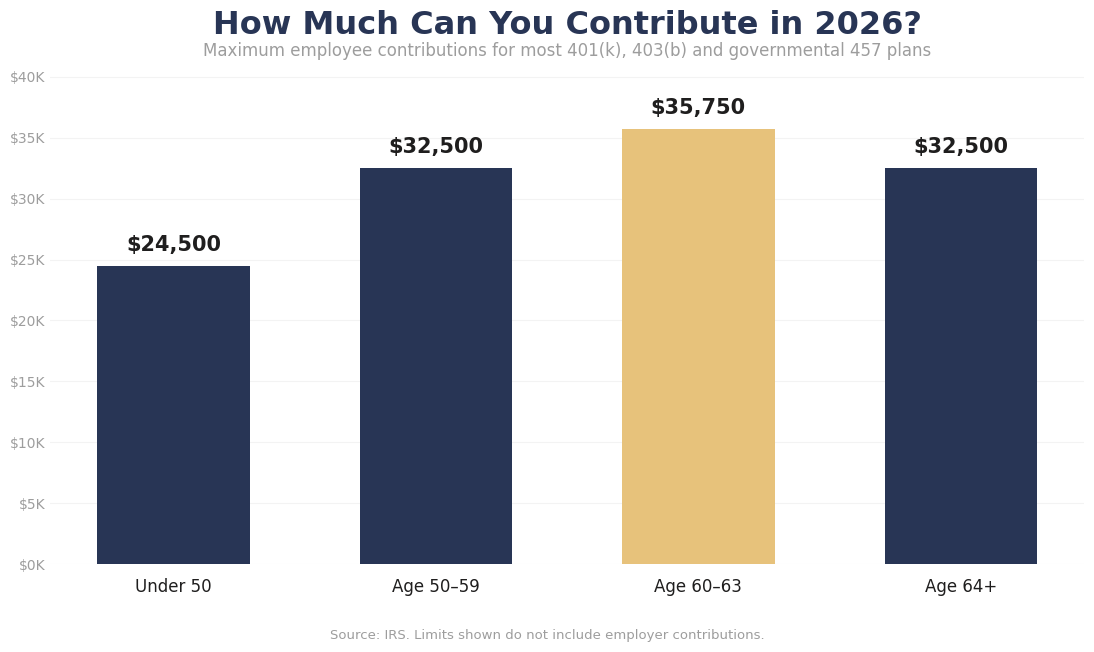
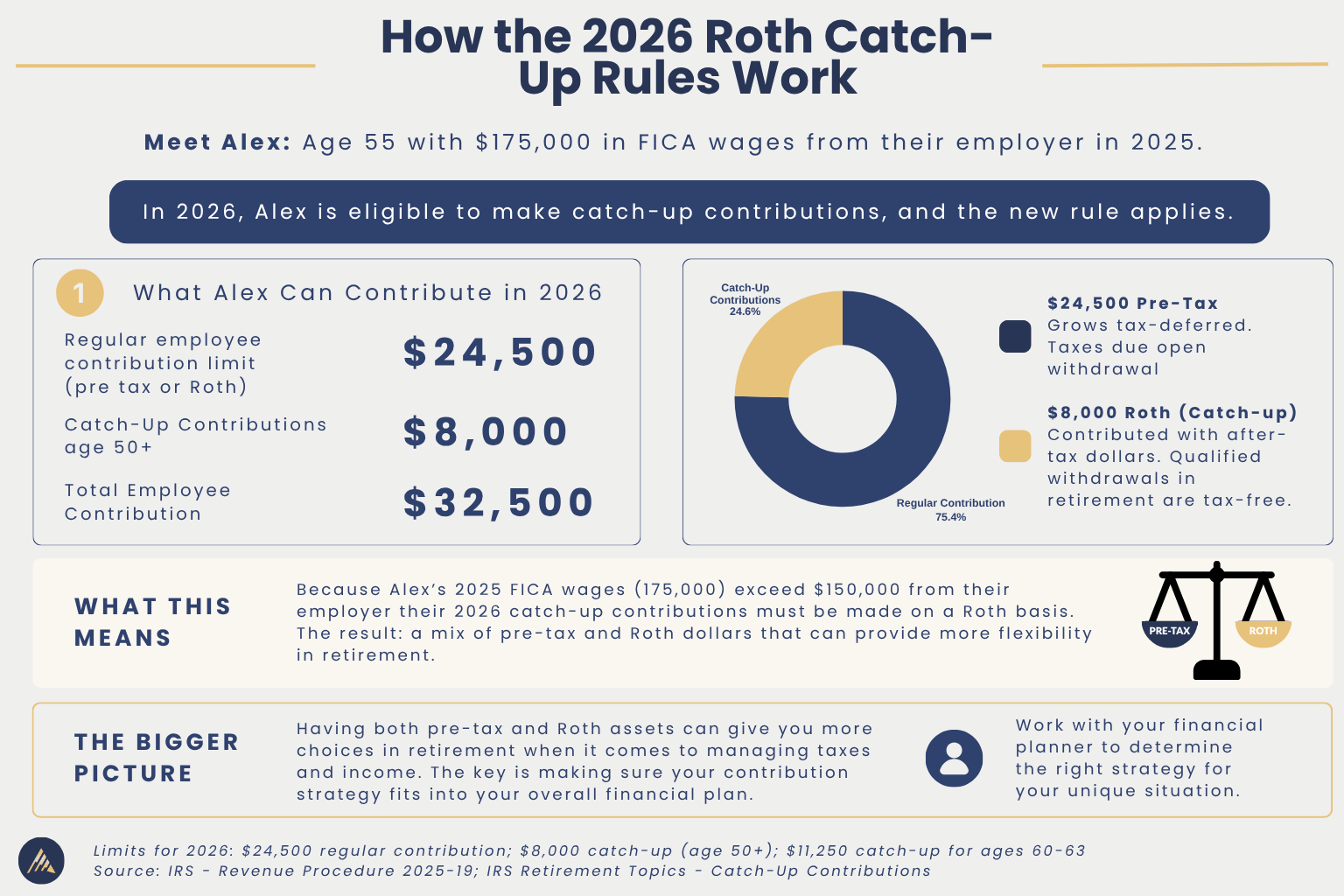
For 2026, the employee contribution limit for most 401(k), 403(b), and governmental 457 plans is $24,500.
For individuals age 50 and older, the standard catch-up contribution limit increased to $8,000, bringing the potential total employee contribution to $32,500 for the year.
There is also a higher catch-up limit for individuals who turn 60, 61, 62 or 63 during the calendar year. In 2026, eligible participants in this age group may make catch-up contributions of up to $11,250 instead of the standard $8,000.
That means someone eligible for the higher catch-up could potentially contribute as much as $35,750 to their workplace plan in 2026, depending on the type of plan and its provisions.
The contribution limits aren’t the only thing that changed.
Beginning in 2026, certain higher earners making catch-up contributions to workplace retirement plans are required to make those catch-up contributions on a Roth basis.
For 2026, the rule generally applies if your 2025 FICA wages from the employer sponsoring the plan exceeded $150,000.
Why does that matter?
Traditional pre-tax retirement contributions can generally reduce taxable income in the year the contribution is made, with taxes paid when the money is withdrawn later.
Roth contributions work differently. They are made with after-tax dollars, so they don’t provide the same upfront income-tax benefit. However, qualified Roth distributions in retirement can generally be taken tax-free.
For someone who has historically directed all of their retirement contributions into a pre-tax account, the new requirement could change both their current tax picture and the mix of taxable and tax-free assets they are building for retirement.
Consider someone who is 55 years old and had $175,000 in FICA wages from their employer in 2025.
In 2026, they could generally contribute up to the regular $24,500 employee limit to their workplace plan. If they want to take advantage of the additional $8,000 catch-up contribution, however, that catch-up amount would generally need to be contributed on a Roth basis under the new rule.
The result could be a retirement account that contains a combination of pre-tax and Roth dollars.
That isn’t necessarily a bad thing. In fact, having different types of accounts available in retirement can create additional flexibility. But it does mean the decision should be viewed as part of a larger tax and retirement strategy rather than simply asking, “How much can I contribute?”
We often talk about diversification in terms of investments, but tax diversification can be important too.
Retirement assets can generally fall into different tax categories, including tax-deferred accounts, Roth accounts and taxable investment accounts. Each can receive different tax treatment when money is eventually withdrawn.
Having assets across multiple tax categories may provide more flexibility when determining where retirement income should come from in a particular year.
The new Roth catch-up requirement could result in some higher earners accumulating more Roth assets than they have in the past. That makes this a good opportunity to look at the bigger picture.
How much of your retirement savings is currently pre-tax? How much is Roth? What might your tax situation look like once you retire? And how do your contribution decisions today fit into your expected income needs later?
There isn’t one answer that works for everyone.
If you’re eligible to make catch-up contributions this year, don’t assume your contribution strategy should look exactly like it did last year.
Review your current contribution elections and confirm which catch-up limit applies to your age. Higher earners should also determine whether the Roth catch-up requirement applies based on their prior-year FICA wages.
From there, consider the change in the context of your broader financial plan.
Your current and expected future tax brackets, existing Roth and pre-tax balances, retirement timeline, income needs and other assets can all play a role in determining how retirement contributions fit into your strategy.
The maximum contribution allowed by the IRS tells you how much you can contribute. It doesn’t necessarily tell you what strategy makes the most sense for you.
Changes to retirement contribution rules can seem small when viewed individually. But decisions made during your highest-earning years can have an impact that extends well beyond a single tax year.
For those approaching retirement, 2026 may be a good time to review not only how much you’re saving, but also where those dollars are going and how they fit into your overall retirement and tax strategy.
Catch-up contributions are one tool. The goal is making sure that tool is working alongside the rest of your financial plan.
Raymond James and its advisors do not offer tax advice. You should discuss any tax matters with the appropriate professional. The foregoing information has been obtained from sources considered to be reliable, but we do not guarantee that it is accurate or complete, it is not a statement of all available data necessary for making an investment decision, and it does not constitute a recommendation.




Neither Raymond James Financial Services nor any Raymond James Financial Advisor renders advice on tax issues, these matters should be discussed with the appropriate professional.
Links to external content or websites, if provided, are for informational purposes only. Raymond James is not affiliated with and does not endorse, authorize or sponsor any of the listed websites or their respective sponsors. Raymond James is not responsible for the content of any website or the collection or use of information regarding any website's users and/or members.
The running stock ticker is not a recommendation to buy or sell stocks of the companies pictured.
Securities offered through Raymond James Financial Services, Inc., member FINRA/SIPC, marketed as Adams Wealth Partners. Investment advisory services offered through Raymond James Financial Services Advisors, Inc.Adams Wealth Partners is separately owned and operated and not independently registered as a broker-dealer or investment adviser.
Certified Financial Planner Board of Standards Inc. owns the certification marks CFP®, CERTIFIED FINANCIAL PLANNER™, CFP® (with plaque design) and CFP® (with flame design) in the U.S., which it awards to individuals who successfully complete CFP Board's initial and ongoing certification requirements. CFP® holders at Adams Wealth Partners, LLC are: David Adams, Myles Zueger, Carson Odom, Spencer Provow, and Nick Wolf.
CPA holders at Adams Wealth Partners, LLC are: David Adams, Carson Odom, and Christine Kinsley
CFA holders at Adams Wealth Partners, LLC are: Anthony Breen.
Please note that all archived content is for informational purposes only. Investment decisions should not be based on the content provided herein. For the most up-to- date statistical information and analysis, please contact your financial professional.
Raymond James financial advisors may only conduct business with residents of the states and/or jurisdictions for which they are properly registered. Therefore, a response to a request for information may be delayed. Please note that not all of the investments and services mentioned are available in every state. Investors outside of the United States are subject to securities and tax regulations within their applicable jurisdictions that are not addressed on this site. Contact your local Raymond James office for information and availability.

2026 Forbes America's Best-In-State Wealth Management Teams, developed by Shook Research, is based on the period from 3/31/2024 to 3/31/2025 and was released on 1/7/2026. Approximately 12,787 team nominations were received and 6,149 advisor teams won. Neither Raymond James nor any of its advisors pay a fee in exchange for this award. More: https://bit.ly/4rXUfUA. Please see https://bit.ly/40mwRVe for more info.
The 2026 Nashville Business Journal Best Places to Work award is based on employee surveys evaluated by Quantum Workplace. To be considered, a company must have a minimum of 10 employees, be located in one of the following counties in TN: Cheatham, Davidson, Maury, Montgomery, Robertson, Rutherford, Sumner, Williamson, or Wilson, and pay a participation fee of $250. Of 100+ companies considered, 40 were recognized. The award is not representative of any one client's experience, is not an endorsement, and is not indicative of an advisor's past or future performance. Raymond James is not affiliated with Nashville Business Journal or Quantum Workplace.
Barron’s Top 1,500 Financial Advisors 2026, is based on the period from 09/30/2024 – 09/30/2025 and was released on 03/20/2026. 7,855 nominations were received and 1,500 won. Neither Raymond James nor any of its advisors pay a fee in exchange for this award. More: https://bit.ly/4smNviU.
Please note that all archived content is for informational purposes only. Investment decisions should not be based on the content provided herein. For the most up-to- date statistical information and analysis, please contact your financial professional.
Raymond James is not affiliated and does not endorse the above-mentioned organizations.
Nashville Wealth Management & Financial Advisors | David Adams CPA, CFP® | Copyright © 2026 | Raymond James Privacy Notice | Raymond James Legal Disclosure